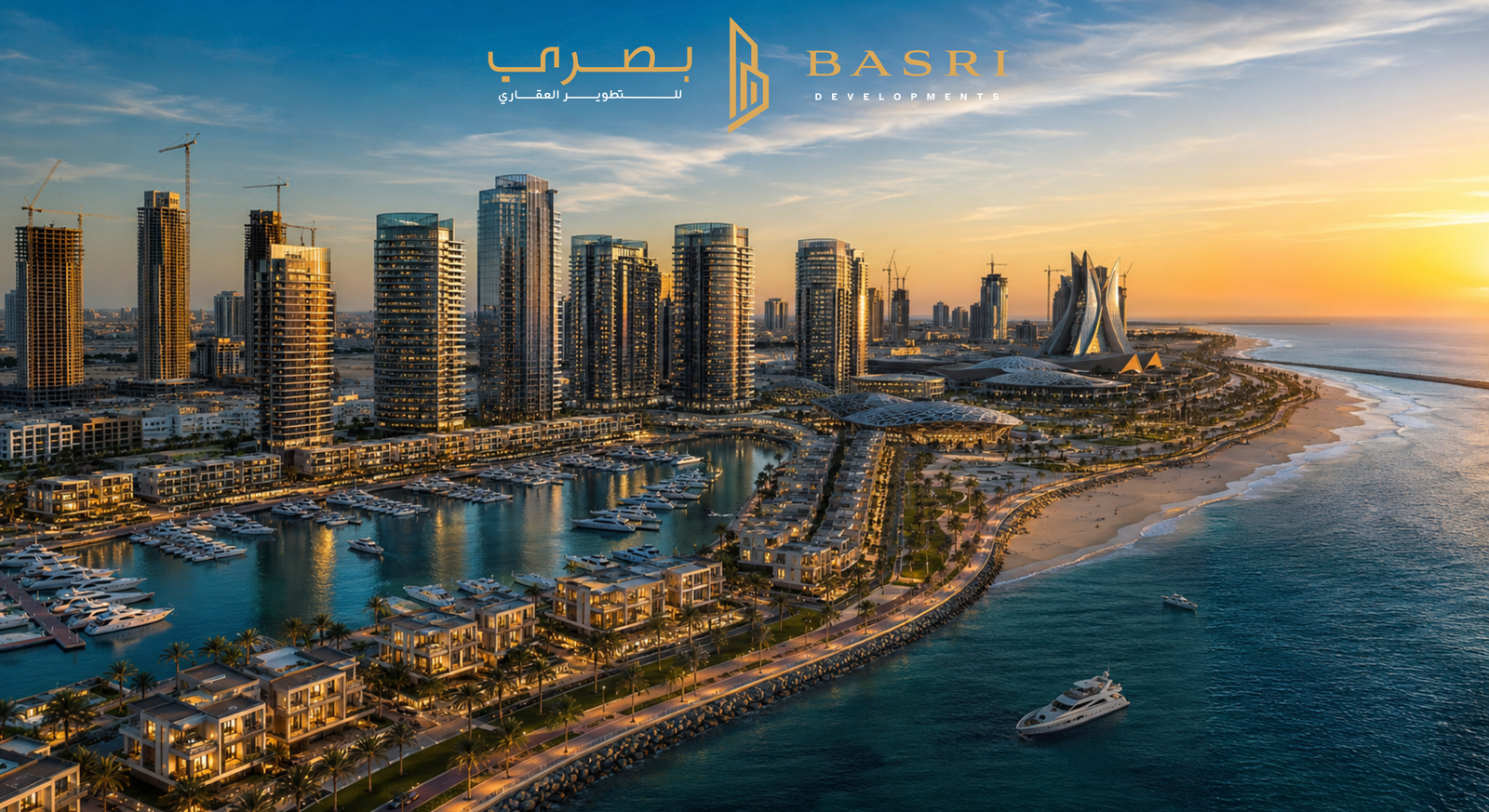
Jeddah’s skyline is changing faster than at any point in a generation, and at the center of it — literally — is Jeddah Central. Backed by the Public Investment Fund and championed personally by Crown Prince Mohammed bin Salman, this SAR 75 billion (roughly $20 billion) waterfront redevelopment is set to become one of the most important real estate stories in Saudi Arabia through 2027 and beyond.
For anyone tracking the Jeddah property market — expats, first-time investors, or seasoned buyers weighing off-plan opportunities — Jeddah Central isn’t just another headline project. It’s already reshaping demand, pricing, and investor sentiment across the neighborhoods that surround it, from Al Balad to Al Hamra and the Corniche waterfront corridor. Here’s what it means for anyone considering property in Jeddah in 2026.
What Is the Jeddah Central Project?
Jeddah Central (previously known as New Jeddah Downtown) is a mixed-use waterfront destination covering 5.7 million square meters in the heart of the city, developed by the Jeddah Central Development Company (JCDC). The masterplan includes a 9.5-kilometer waterfront, a 2.1-kilometer sandy beach, a world-class yacht marina, and four flagship landmarks: an opera house, a museum, a sports stadium, and an oceanarium.
Beyond the cultural landmarks, the project will deliver a substantial mix of residential units, retail, hospitality, and leisure space, positioned to capitalize on Jeddah’s role as the Kingdom’s gateway to the Red Sea, Makkah, and Madinah. Construction is being rolled out in three major phases, with the first phase — covering roughly 45% of the site — on track for completion by the end of 2027.
Why Jeddah Central Matters for Property Buyers Right Now
Mega-projects of this scale tend to move real estate markets long before they’re finished, and Jeddah Central is already doing exactly that. A few reasons this matters if you’re considering buying in Jeddah in 2026:
- Infrastructure changes perception before it changes skylines. Corridors connected to Jeddah Central — improved roads, public-realm upgrades along the Corniche, and expanded waterfront access — are already lifting buyer interest in surrounding districts.
- Jeddah’s broader development pipeline is enormous. Analysts estimate a roughly $90 billion development pipeline reshaping the city, with Jeddah Central as its centerpiece alongside northward growth corridors.
- Branded and luxury residential supply is expanding. Around 1,000 branded residential units are planned for delivery by 2030, on top of roughly 400 that already exist — a segment that barely existed in Jeddah a few years ago.
- Institutional confidence is rising. With capital-market reforms channeling more funds into income-generating property and giga-projects tied to Expo 2030, the Riyadh Metro-style national infrastructure push, and the FIFA World Cup 2034, Jeddah is being positioned as a long-term investment city, not just a lifestyle one.
Which Jeddah Neighborhoods Benefit Most
Not every district benefits equally from a project like this. Based on current market data, the areas seeing the strongest ripple effects from Jeddah Central and the broader Corniche redevelopment are:
Al Balad (Historic Jeddah) As the project sits adjacent to the city’s historic core, Al Balad is being positioned for a heritage-led revival, with renewed interest in restoration and boutique residential-commercial conversions.
Al Hamra Already one of Jeddah’s three most expensive districts, Al Hamra benefits from its central Corniche location, proximity to consulates, and consistent demand for furnished units from executives and diplomats. Prime pricing here runs roughly SAR 8,000–18,000 per square meter.
Al Shati Jeddah’s premium waterfront address, known for direct Red Sea access and yacht-club living. Ultra-prime sea-view units here can exceed SAR 20,000 per square meter, and vacancy in this corridor is notably tight — estimated at just 3–6%, compared to 6–9% citywide.
Al Nahda and Al Zahra Slightly more accessible price points with strong family appeal, benefiting from improved connectivity as Corniche infrastructure projects extend north.
North Jeddah / Obhur While technically outside the immediate Jeddah Central footprint, Obhur continues to draw off-plan investors on the back of the same tourism and coastal-lifestyle momentum, with entry prices around SAR 4,000–5,000 per square meter and projected appreciation of 15–20% as tourism infrastructure builds out.
Jeddah Property Prices: Where Things Stand in 2026
Jeddah’s citywide average apartment price sits at approximately SAR 4,300–4,400 per square meter, up roughly 2.7% year-on-year — a much steadier trajectory than Riyadh, where apartment rents alone jumped nearly 20% year-on-year. That relative stability is part of Jeddah’s appeal: historical price swings have generally stayed in the 5–15% range, versus 10–25% in Riyadh’s more volatile cycles.
Average annual returns on Jeddah apartments currently range between 6% and 12%, with the highest yields concentrated in newly developed districts and emerging corridors like North Obhur and the Haramain rail corridor. Days-on-market in Jeddah average around 60–70 days — slightly longer than Riyadh, which rewards buyers who are patient and selective rather than chasing the fastest-moving listings.
The Off-Plan Advantage Near a Mega-Project
If there’s one lesson from every giga-project across the Gulf, it’s this: the earlier investors buy relative to a mega-project’s completion date, the larger the eventual appreciation. With Jeddah Central’s first phase targeted for late 2027, 2026 sits in a window where off-plan pricing in the surrounding corridors has not yet fully priced in the project’s long-term impact.
This is especially relevant for buyers who’ve already been exploring Jeddah’s off-plan market — the same fundamentals that make projects like Jawharat Al-Arous or Elementa in Al Rehab attractive apply here, but with the added catalyst of a $20 billion government-backed anchor project driving tourism, retail footfall, and long-term rental demand in the immediate vicinity.
What This Means If You’re Buying or Investing in Jeddah in 2026
- Location within the ripple zone matters more than ever. Proximity to Jeddah Central, the Corniche corridor, and improving road networks is becoming a measurable price driver, not just a lifestyle preference.
- Branded and lifestyle-led residences are gaining ground. As Jeddah’s luxury segment matures, buyers are increasingly choosing developments that offer resort-style amenities and design credibility over generic stock.
- Foreign ownership reforms add fuel. With Saudi Arabia’s new property ownership law for non-Saudis now in effect, international interest in exactly these waterfront-adjacent districts is expected to accelerate through 2026 and 2027.
- Patience pays. Jeddah’s steadier, less speculative price behavior compared to Riyadh or Dubai means this is a market that rewards well-researched, medium-to-long-term positioning rather than short-term flipping.
Final Thoughts
Jeddah Central is more than a construction project — it’s a signal of where the city is heading over the next decade. For buyers and investors evaluating Jeddah real estate in 2026, understanding how this project reshapes value across Al Balad, Al Hamra, Al Shati, and the wider Corniche corridor is quickly becoming essential due diligence, not optional reading.
If you’re exploring where to buy in Jeddah before the market fully catches up to Jeddah Central’s impact, our team at Basri Developments can walk you through the areas, price points, and off-plan opportunities positioned to benefit most.
Frequently Asked Questions (FAQs)
Jeddah Central is a SAR 75 billion ($20 billion) waterfront redevelopment project covering 5.7 million square meters in central Jeddah, developed by the Jeddah Central Development Company under the Public Investment Fund. It includes a marina, beach, opera house, museum, stadium, oceanarium, and extensive residential and hospitality space.
The project is being delivered in three phases. Phase 1, covering about 45% of the site, is targeted for completion by the end of 2027, with full completion extending into the following years.
Al Balad, Al Hamra, and Al Shati are seeing the most direct impact due to their proximity to the project, followed by Al Nahda, Al Zahra, and the broader Corniche corridor.
With Phase 1 still under construction and surrounding-area pricing not yet fully reflecting the project’s long-term impact, 2026 represents an early-stage window for off-plan and resale buyers, particularly with foreign ownership rules now more accessible.
Prime districts like Al Hamra and Al Shati currently range from SAR 8,000 to over SAR 20,000 per square meter for premium sea-view units, while the citywide Jeddah average sits closer to SAR 4,300–4,400 per square meter.