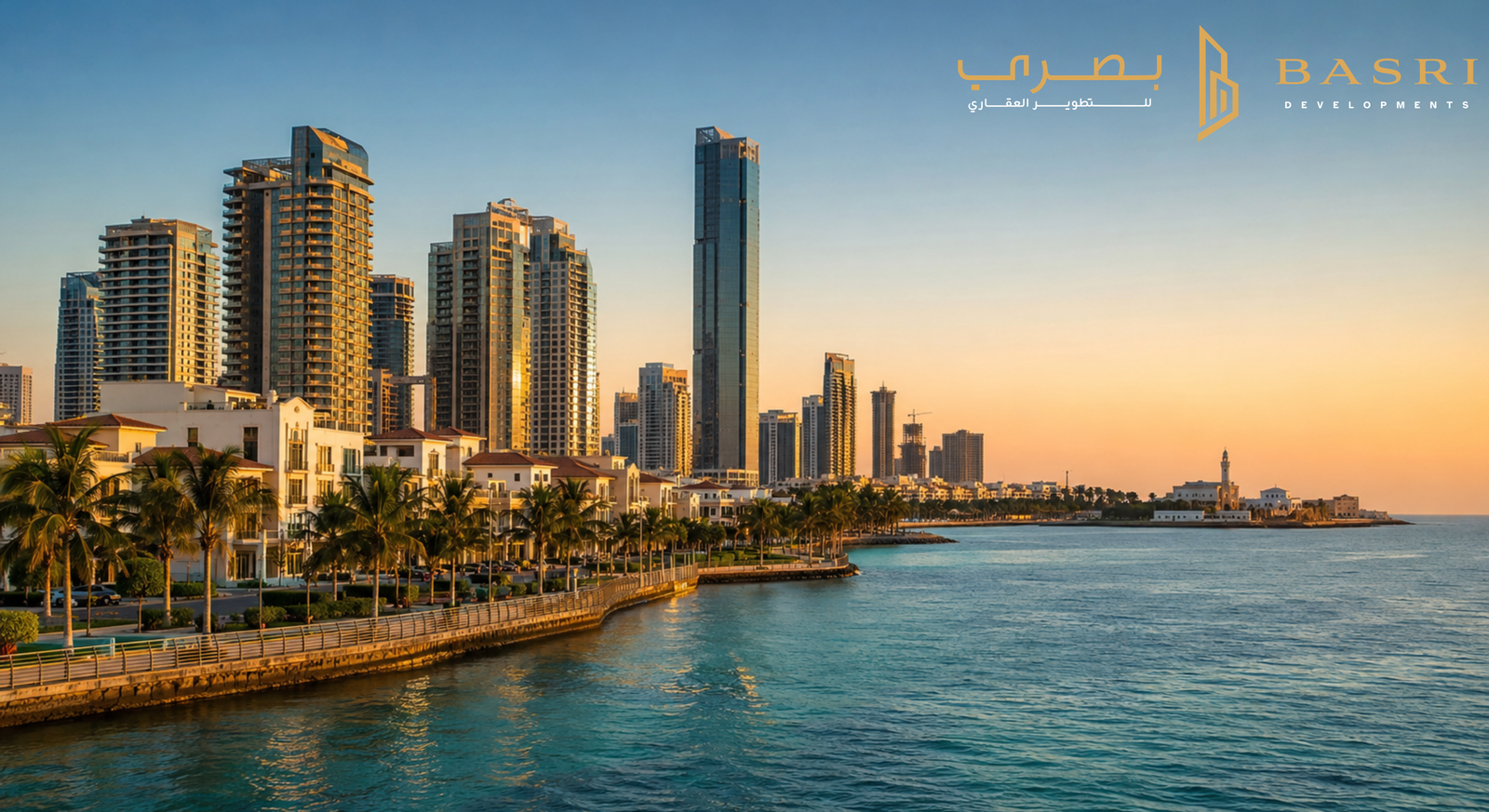
Ask five different Jeddah property investors where to buy and you’ll likely get three different answers: Al Shati, Al Hamra, and Al Balad. All three sit along or near the same Corniche corridor. All three are benefiting from the ripple effects of Jeddah Central and the city’s wider waterfront redevelopment. And all three show up constantly in “best areas to invest in Jeddah” searches — for good reason.
But they are not interchangeable. Al Shati is Jeddah’s premium waterfront address. Al Hamra is the city’s established, centrally located heavyweight. Al Balad is a heritage district in the middle of a tourism-led revival. Choosing between them depends entirely on what you’re optimizing for — capital appreciation, rental yield, lifestyle, or ticket price. Here’s how they actually compare.
Al Shati: The Premium Waterfront Play
Al Shati sits along Jeddah’s northern Corniche, directly on the Red Sea, and it trades on that position. This is the district for buyers chasing prestige, resale strength, and the highest price ceiling in the city.
Pricing: Villas start around SAR 4 million and can reach SAR 10 million for a 300 sqm seafront property with a pool. Apartments in prime sea-view buildings can command upward of SAR 20,000 per square meter, among the highest in Jeddah.
Rental yields: Roughly 7–8.5%, driven by strong demand from expatriates and short-term visitors. Short-term rental performance is especially strong here, with top units generating SAR 8,000–25,000 per month depending on size and view.
Price growth: Property values rose approximately 5% in 2024, and the district continues to benefit from ongoing Corniche public-realm upgrades — new lighting, sea walls, and pedestrian improvements.
Who it’s for: Investors and end-users who want the strongest long-term prestige asset in Jeddah and can absorb a higher entry price. Al Shati is less about yield efficiency and more about owning the best-positioned real estate in the city.
Al Hamra: The Established Central Powerhouse
Just south of Al Shati, Al Hamra offers a different value proposition — centrality, established infrastructure, and consistent demand without Al Shati’s premium ceiling.
Pricing: Typical asking prices range from SAR 8,000–18,000 per square meter, meaningfully below Al Shati’s top end while still commanding some of the highest prices in the city.
Rental yields: Similarly strong at 7–8.5%, with steady 4–5% annual price appreciation. Al Hamra’s furnished-apartment stock is in high demand from executives, consulate staff, and business travelers, giving it some of the most resilient occupancy in Jeddah.
Reinvestment signals: Al Hamra is actively gentrifying — facade renovations on older apartment blocks, smart-tech and solar retrofits on villas, and commercial refreshes like the recent Centro Al Hamra update are pulling in younger residents and renters.
Who it’s for: Investors who want Al Shati-adjacent prestige and strong rental performance at a somewhat lower entry price, plus buyers prioritizing walkability, consulate-district access, and furnished-rental demand.
Al Balad: The Heritage Revival Story
Al Balad — historic Jeddah — is a different kind of opportunity entirely. This UNESCO World Heritage-listed district is in the early stages of a government-backed restoration program, and that changes the investment thesis completely.
What’s happening: The Jeddah Historic District Program is restoring more than 600 heritage buildings. Three properties — Jokhdar House, Al-Rayyis House, and Kedwan House — were converted into luxury hotels in 2024 under Al Balad Development Company, and boutique cafes and restaurants are increasingly moving into restored heritage buildings.
Rental performance: Al Balad ranks among Jeddah’s top three districts for short-term rentals, driven by heritage tourism, cultural festivals, and event-driven demand spikes. It sits alongside Al Shati and Al Hamra as one of the strongest short-term rental performers in the city.
Price trajectory: Along with Al Hamra and Al Andalus, Al Balad has seen an estimated 10–20% price appreciation over the past two to three years — outperforming Jeddah’s broader citywide average.
Who it’s for: Investors comfortable with a longer-horizon, heritage-tourism-driven thesis rather than immediate luxury-rental income. This is closer to an early-stage gentrification play than a stabilized luxury market — higher potential upside, but a different risk profile than Al Shati or Al Hamra.
Side-by-Side Snapshot
| Al Shati | Al Hamra | Al Balad | |
|---|---|---|---|
| Positioning | Premium waterfront | Established central | Heritage revival |
| Typical price range | Up to SAR 20,000+/sqm | SAR 8,000–18,000/sqm | Lower entry, early-stage upside |
| Rental yield | 7–8.5% | 7–8.5% | Strong short-term demand, tourism-driven |
| 2024 price growth | ~5% | 4–5% annually | 10–20% (2–3 year trend) |
| Best suited for | Prestige & resale strength | Yield + centrality | Long-horizon upside |
The Common Thread: Jeddah Central’s Ripple Effect
All three neighborhoods sit within the influence zone of Jeddah Central, the $20 billion PIF-backed waterfront mega-project reshaping the city’s core. Infrastructure upgrades along the Corniche — road connections, waterfront public realm, and the wider $90 billion citywide development pipeline — are already lifting sentiment across all three districts before the project’s first phase even completes in 2027.
That means the decision between Al Shati, Al Hamra, and Al Balad isn’t really about which one benefits from Jeddah’s growth story — it’s about which segment of that story matches your investment goals.
Final Thoughts
There’s no single “best” district among Al Shati, Al Hamra, and Al Balad — only the best fit for your strategy. Want the highest-prestige, highest-ceiling asset in Jeddah? Al Shati. Want strong yields with lower entry cost and central convenience? Al Hamra. Want early-stage upside tied to a heritage tourism boom? Al Balad.
If you’re weighing these three against each other for your own portfolio, our team at Basri Developments can walk you through current listings, off-plan opportunities, and realistic entry points across all three corridors.
Frequently Asked Questions (FAQs)
Al Shati generally commands the higher ceiling, with prime sea-view apartments exceeding SAR 20,000 per square meter, compared to Al Hamra’s typical range of SAR 8,000–18,000 per square meter.
Al Balad is in an active heritage-restoration phase backed by the Jeddah Historic District Program, with 10–20% price appreciation over the past two to three years. It suits investors comfortable with a longer, tourism-driven growth thesis rather than an already-stabilized luxury market.
Al Shati and Al Hamra both offer rental yields in the 7–8.5% range, among the strongest in the city, while Al Balad performs particularly well for short-term, tourism-linked rentals.
Yes. All three sit within or near Jeddah Central’s zone of influence and are already benefiting from Corniche infrastructure upgrades ahead of the project’s Phase 1 completion in 2027.